Abnormal Traffic Detection, Analysis and Control System – Korea Telecom
Altibase delivers a unified solution to Korea Telecom, streamlining core systems while reducing server requirements by 80%.
- Use Case
- Network Management
- Current Customer
- KT and LG Uplus
- Industry
- Telecommunications
Who
Problem
The existing system configuration was unstable when high volumes of data were being processed.
KT experimented with a few solutions that compromised stability with the hope of increasing overall performance. Unfortunately, the tradeoff resulted in an unstable system that did not perform well.
Overloaded and bogged down by multiple processes tied into a single system, KT was stymied. Expanding the system for better performance and stability meant splitting the processes.
Upgrading the system for this type of expansion was difficult to implement and came with a hefty price tag. The total related costs were untenable.
Solution
Results
KT has been empowered with the ability to analyze data in real time and react accordingly.
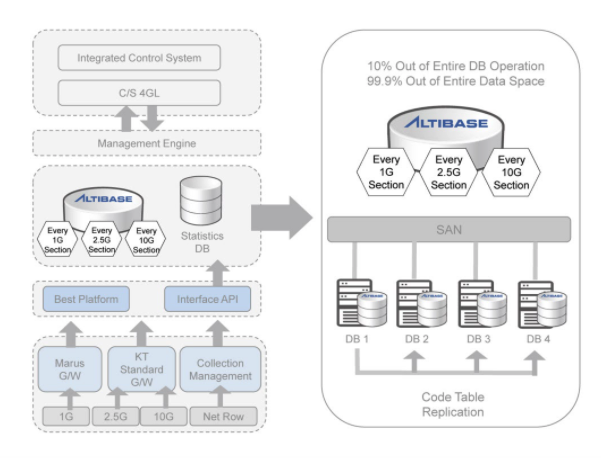
KT has profited from Altibase’s hybrid architecture capitalizing on in-memory tables for frequently accessed, current data while keeping less active, historical data on on-disk tables.
KT was able to move away from batch processing to real time processing.
Altibase’s built-in replication feature and resultant active-standby system have allowed KT to deliver real time and non-stop service.
The number of active servers has been reduced to 4 from over 20.
System resource usage is down by 65%.
By using the parallel architecture model, on-demand system expansion has become easier.